Artificial intelligence is no longer evolving as isolated models.
A deeper architectural transition has begun.
The first era of computing virtualized hardware.
The second virtualized infrastructure.
The third connected global information networks.
The fourth introduced machine learning systems capable of pattern recognition.
Now a fifth layer is emerging:
Contents
Cognitive Runtime Infrastructure.
Not software.
Not merely AI.
But continuously adaptive systems capable of:
- reasoning
- memory
- orchestration
- governance
- semantic coordination
- distributed cognition
across institutions, infrastructures, and societies.
Your earlier articles explored:
- the rise of Cognitive Operating Systems
- the emergence of Cognitive Runtime Infrastructure
The next evolution extends beyond both.
We are entering the age of:
The Semantic Civilization Stack.
From Information Systems to Cognitive Systems
Traditional software systems process:
- requests
- transactions
- workflows
- data pipelines
Cognitive systems process:
- context
- memory
- intent
- reasoning
- causality
- semantic meaning
This distinction is critical.
Information systems answer:
What happened?Cognitive systems answer:
Why did it happen?
What does it mean?
What should happen next?
That shift fundamentally changes computing architecture.
The Limitations of Current AI Infrastructure
Today’s AI ecosystem is still built on fragmented primitives:
- isolated models
- disconnected memory
- centralized inference
- static orchestration
- expensive scaling
- shallow context windows
Most AI applications remain:
stateless.
They generate responses but lack:
- durable cognition
- institutional memory
- causal continuity
- strategic understanding
- adaptive governance
As AI systems become embedded into:
- enterprises
- governments
- infrastructure
- finance
- logistics
- healthcare
- defense
this architectural weakness becomes existential.
Civilization-scale cognition cannot operate on disconnected prompts.
The Emergence of the Semantic Civilization Stack
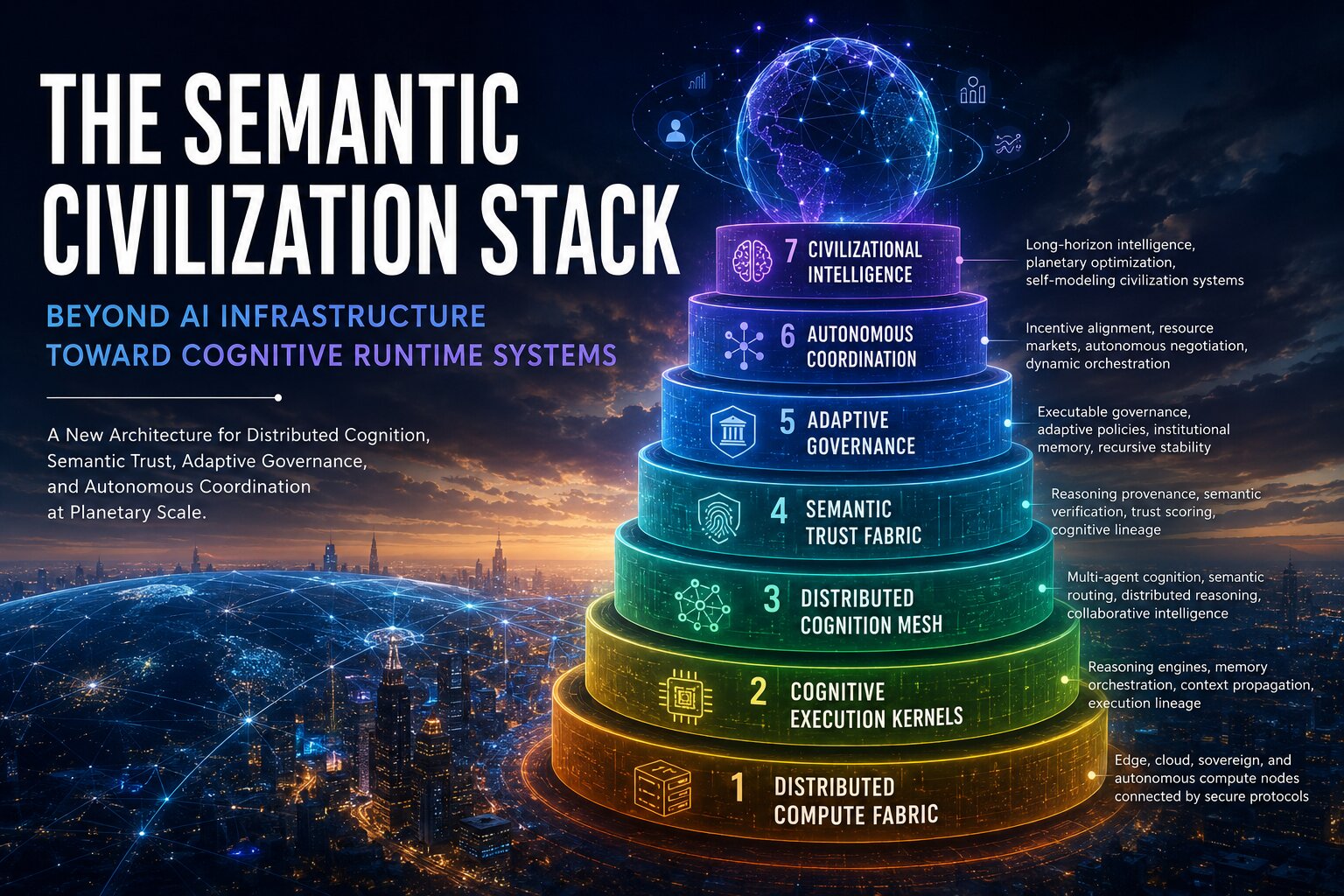
The Semantic Civilization Stack introduces a new architectural model.
Instead of treating AI as isolated intelligence, it treats cognition itself as:
Infrastructure.
The stack evolves through layered cognition systems.
Layer 1 — Distributed Compute Fabric
The foundation is no longer centralized hyperscale infrastructure alone.
Future cognition systems operate across:
- cloud environments
- edge devices
- sovereign compute
- local inference clusters
- distributed accelerators
- autonomous execution nodes
The objective is not infinite compute.
The objective is:
Maximum cognition density at minimum infrastructure cost.
This changes cloud economics fundamentally.
Layer 2 — Cognitive Execution Kernels
Operating systems once managed:
- memory
- CPU scheduling
- hardware abstraction
Cognitive kernels manage:
- reasoning execution
- semantic routing
- memory synthesis
- context propagation
- execution lineage
- distributed cognition scheduling
This is where infrastructure begins behaving less like software and more like:
Adaptive cognition substrates.
Layer 3 — Distributed Cognition Meshes
Today’s AI systems are centralized.
Future systems become:
cognition meshes.
Instead of:
user → centralized modelwe move toward:
agents ↔ institutions ↔ infrastructure ↔ semantic memoryCognition becomes:
- distributed
- composable
- specialized
- cooperative
- continuously adaptive
This creates civilization-scale inference networks.
Layer 4 — Semantic Trust Infrastructure
Blockchain introduced distributed trust for transactions.
But civilization cognition requires:
semantic trust.
The next generation of systems must verify:
- reasoning provenance
- causal lineage
- semantic integrity
- epistemic consistency
- governance alignment
Future infrastructure will require:
- reasoning signatures
- semantic verification
- cognitive lineage graphs
- explainable execution trails
- trust-weighted cognition systems
The challenge is no longer:
Can we trust the transaction?It becomes:
Can we trust the reasoning?Layer 5 — Adaptive Governance Systems
Traditional governance structures are:
- static
- bureaucratic
- reactive
Cognitive runtime systems require:
executable governance.
Policies become dynamic runtime constraints capable of:
- adapting to changing conditions
- enforcing semantic boundaries
- regulating autonomous agents
- preserving recursive stability
- preventing systemic drift
Governance evolves from documents into:
living computational systems.
Layer 6 — Autonomous Coordination Economies
Human civilization currently suffers from:
- fragmented coordination
- institutional latency
- cognitive bottlenecks
- information silos
- incentive misalignment
Semantic runtime systems introduce:
autonomous coordination architectures.
These systems dynamically allocate:
- compute
- memory
- cognition
- resources
- planning capacity
- infrastructure execution
based on:
- semantic value
- entropy reduction
- governance importance
- strategic relevance
The result is:
cognition-aware economic infrastructure.
Layer 7 — Civilizational Intelligence
This is the final emergent layer.
Not artificial general intelligence.
Something broader.
A continuously adaptive civilization cognition field capable of:
- long-horizon forecasting
- institutional simulation
- strategic optimization
- semantic continuity
- distributed governance
- recursive self-improvement
The system becomes:
- self-modeling
- self-coordinating
- self-optimizing
- self-healing
across planetary-scale infrastructure.
Why This Matters
Every major civilization transition has historically followed a change in coordination architecture.
Agriculture changed food coordination.
Industry changed energy coordination.
The internet changed information coordination.
Cognitive runtime infrastructure changes:
cognition coordination itself.
That is the real inflection point.
The future competitive advantage will not belong solely to:
- larger models
- bigger datacenters
- more GPUs
It will belong to systems capable of:
- integrating memory
- orchestrating reasoning
- governing recursion
- minimizing entropy
- coordinating distributed cognition
at planetary scale.
The Shift Beyond Software
Software transformed workflows.
Cloud transformed infrastructure.
AI transformed interfaces.
Semantic civilization systems transform:
civilization cognition.
This is not simply another software category.
It is the emergence of:
civilization-scale cognitive infrastructure.
The Next Decade
Over the next decade we are likely to see:
- semantic execution fabrics
- cognition-aware operating systems
- distributed reasoning meshes
- adaptive governance engines
- autonomous coordination markets
- persistent institutional memory systems
- semantic trust architectures
Together these systems will form the foundation of:
Cognitive Civilization Infrastructure.
The systems that emerge from this transition will redefine:
- economies
- institutions
- governance
- infrastructure
- intelligence itself
in ways comparable to:
- electricity
- industrialization
- the internet
- cloud computing
combined.
Final Thought
The most important infrastructure layer of the next century may not be:
- cloud platforms
- social networks
- blockchain ledgers
- AI models
It may be:
semantic cognition infrastructure.
Because the ultimate bottleneck of civilization has never been computation alone.
It has been:
- coordination
- memory
- governance
- trust
- collective intelligence
The Semantic Civilization Stack represents the first serious attempt to architect these capabilities as a unified computational substrate.
And that may ultimately become the foundation for the next phase of human civilization itself.
FAQ
1-What is the Semantic Civilization Stack?
The Semantic Civilization Stack is an emerging architecture for distributed cognition, semantic trust, adaptive governance, and autonomous coordination across large-scale AI systems.
2- What is Cognitive Runtime Infrastructure?
Cognitive Runtime Infrastructure refers to systems capable of persistent reasoning, memory orchestration, semantic coordination, and adaptive execution across distributed environments.
3- How is the Semantic Civilization Stack different from traditional AI systems?
Traditional AI systems are often stateless and isolated, while the Semantic Civilization Stack focuses on persistent memory, distributed cognition, governance, and semantic trust infrastructure.
4- Why is semantic trust important in AI systems?
Semantic trust enables systems to verify reasoning provenance, causal lineage, and contextual integrity instead of validating only transactions or raw data.
The next generation of civilization infrastructure may not be built solely on cloud computing or artificial intelligence – but on semantic cognition systems capable of coordinating memory, governance, trust, and intelligence at planetary scale.
Earlier articles: